|
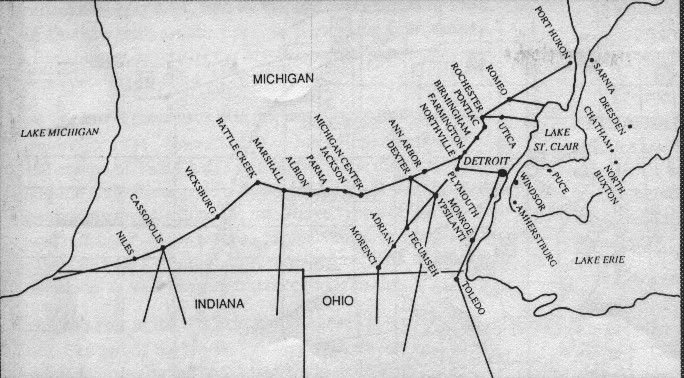
A mile northwest of Utica, Michigan just off Woodall Road,
slabs of pitted concrete jut above thick brush, remnants of
an antebellum farmhouse; spindly young trees dot the
gently rolling land, reclaiming the homestead.
Spring Hill Farm offered 19th century refuge for southern
slaves' flight to Canada and a respite for former
heavyweight Joe Louis who used the estate as a training
camp from 1939 to 1944.
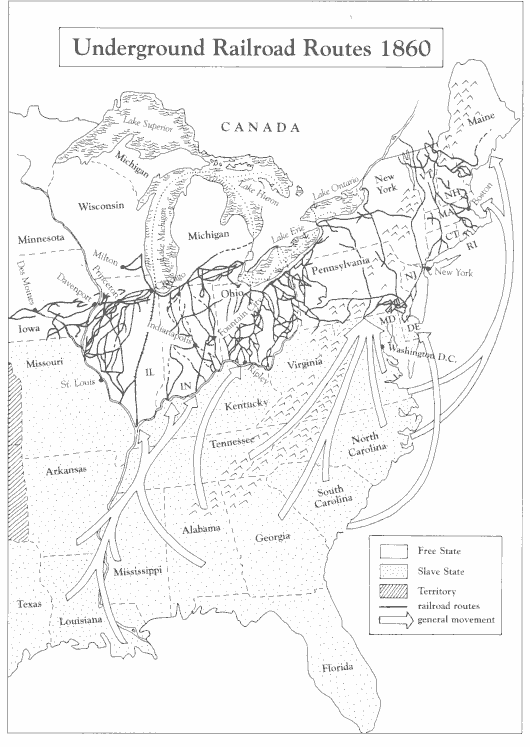
The underground railroad was neither underground nor a
railroad, but a labyrinth of escape routes from "slave states"
in the south to northern "free states", and on to Canada.
Slaves traveled by night and hid during the day, their hiding
places called stations and those who aided their transport
and shelter termed conductors.
Spring Hill, named for its spring-in-the-hill, was a weigh
station on the railroad during the decade prior to the Civil
War. Owner Peter Lerich and his family were willing
conductors.
Just above the spring in the hill, on a June morning in the
1850's, Lerich's neighbors dug a deep hole, according to a
account by his daughter, Libereta Lerich Green.
"They dug and threw out the dirt", she remembered, "until
their heads were out of sight."
An immense cedar tree, so large it was carried by three
oxen-drawn sleighs, was carefully placed in the hole. It
came to be known as the Beacon Tree and Green recalled "
many dark skinned men and women have blessed the day
they sighted (it)"...24 miles directly north of Detroit City Hall
and just 12 miles directly east of Pontiac Court House,
County of Macomb, State of Michigan.
For the next 10 years, until the first shot of the Civil War was
fired at Fort Sumter, legions of slaves fled toward the
Beacon Tree. Once there, they crept along a fence at the
spring, slid down the top pole and dropped off into their
tracks from dogs and bounty hunters. Finally, they slipped
through a small door in the hillside. Sustained by food and
drink from the Lerich kitchen, the fugitives waited for cover of
night to resume their journey.
Slavery in America was abolished in 1865 by the 13th
Amendment to the Constitution.
The Beacon Tree fell in 1888 when Peter Lerich sold Spring
Hill to the McVitte family, who chopped it into fence posts.
Archibald McVitte later sold the farm to Charles Weeks of
the Weeks Lumber Company who owned the property for
nearly 30 years. Herman Breede an employee of Weeks,
settled into it with his family and spent many years as
Spring Hill's caretaker.
In 1939, John Roxborough, manager of heavyweight
champion Joe Louis, closed a deal securing the 500-acre
farm as a training camp for the famous boxer. A well was
dug, and the first electric lines were installed along Hamlin
Road. When Louis acquired the farm, "Uncle Peter Lerich"
was still stenciled on a roadside barn.
Today, the Spring Hill site is part of River Bends Park in
Shelby Township, Mi. ( The Source Newspaper 6-29-92)
THE BEACON TREE
The Underground Railroad-National Geographic
|