|
About 1,100 British troops led by Major Patrick Ferguson were camped atop the mountain, and the commander declared that "
even the almighty can not drive me from it. "
So it was on October 7, 1780 when Isaac Shelby helped lead buckskin-clad American sharpshooters to victory, driving the
British from King's Mountain, which paved the way for the defeat of the British troops under Lord Cornwallis. This was his
most noteworthy wartime accomplishment.
Born on December 11,1750, Isaac Shelby seemed destined to become a soldier. His father served with distinction in the
French and Indian War. In 1774 Isaac served as lieutenant in his father's company at the Battle of Point Pleasant.
Moving to Traveler's Rest, Shelby completed his stone house in 1786. In 1783 he was appointed a trustee of Transylvania
Seminary. He also worked as a surveyor and was High Sheriff of Lincoln County. He belonged to the war board appointed by Congress
to provide defense of the frontier and participated actively in the ten conventions that led to Kentucky's statehood in 1792.
After his victory at King's Mountain, Shelby returned to Kentucky and married his childhood sweetheart Susannah Hart on
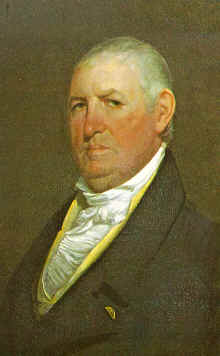
April 19,1783. On his wedding day a historian described Shelby as " a heavy rugged fellow, with a ruddy face, firm lips,
and a resolute eye."
Isaac Shelby was equally at home on the fields of battle or in the halls of government. Shelby was known for his common
sense, diplomacy, and self-control, making him a likely choice to lead the transformation of Kentucky from primitive wilderness
into American statehood.
A member of the 1792 convention that drew up Kentucky's first constitution, Shelby was elected governor and took office
on June 4th. During this term he pushed for improvement of the Wilderness Road making it safer and more navigable. After serving
four years he declined re-election and retired to his Lincoln County farm, known as Traveler's Rest, to farm and raise cattle.
For sixteen years Shelby prospered from the sale of horses and mules to southern cotton planters. When the war of 1812
broke out, Kentucky called on its 61-year-old hero to serve a second term as governor. Shelby responded by organizing and
leading an army of Kentuckians that defeated the British at Thames, Canada in 1813.
His efforts earned him a resolution of thanks and a gold medal from the United States Congress. He refused because of
age an offer from President James Monroe in 1817 to serve as Secretary of War. His last public service came in 1818 when he
joined Andrew Jackson to draw up a treaty with the Chicksaw Indians for 4,600 square miles of land in western Kentucky and
Tennessee known as the Jackson Purchase.
After his second term as governor, Shelby returned to his beloved Traveler's Rest to farm and his home was open to any
soldier who passed by it. He died of apoplexy on July 18,1826 while sitting with his wife on his front porch and was buried
at Traveler's Rest on a spot he marked for his grave.
We do not know by whom or when our township received its name of Shelby. There are no fewer then nine counties in the
country named after Shelby.
Isaac Shelby's actions in 1813 at the Battle of Thames occurred at a time when the nation was in a crisis. The whole
western frontier was menaced by a savage foe, aided and supported by British intrigue, our first army captured, and the Michigan
territory in possession of the enemy.
He became the rallying point of patriotism. It was his unauthorized though judicious step, which he assumed upon his own
responsibility, of calling out mounted volunteers that produced the memorable victory on the Thames.
It's assumed that in 1818 Isaac Shelby and his accomplishments were known throughout the Michigan Territory and to those
persons surveying the township now known as " Shelby."
|