|
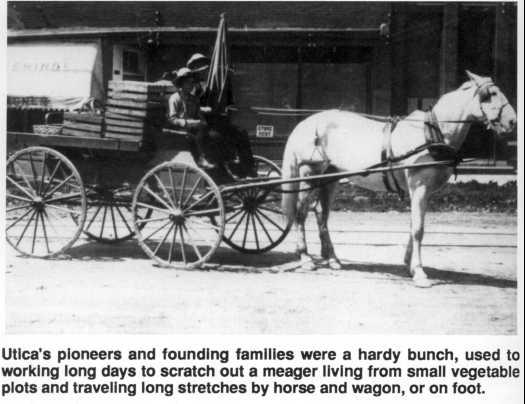
The family of Nathaniel Squires came to what is now Utica in 1817. His daughter Joclamy was the first white child born
in the settlement. His son Thomas was the first to die.
The family began its trek from the Vermont hills, stopping for a time in Canada, before reaching Michigan. Traveling by
raft and canoe, they docked near Mount Clemens, transferred their goods to an oxcart, and continued their journey through
a forest path.
The Squires took refuge in an abandoned house near Frederick (present day Mt.Clemens) from which Elisha Harrington and
his family had fled fearing Chippewa attack. When the Harringtons returned from Detroit after the War of 1812, the Squires
were forced to move.
Repacking their cart, Nathaniel and Jemima, and their sons Hiram and Thomas , headed west through the woods until May
of 1817 when they came upon the crossing of two Indian trails near the Clinton River, which were well traveled by the Chippewa
Indians. Today those paths are Cass and Auburn Roads.
As Jemima was soon to give birth, they built a shelter and cleared some land, planting corn, potatoes and buckwheat. By
the time their daughter was born in July, the Squires had settled into their small, cob-roofed log cabin on the southeast
corner of what is now Cass and Auburn Roads.
Nathaniel and Thomas found summer jobs harvesting near Mount Clemens, taking their pay in wheat, which they had ground
into flour at the Trombley Mill near Frederick. During the winter months, the men carried wooden pickets which William "Pickett"
Smith had planned to float down the Clinton River for sale in Detroit. Smith's was a short lived enterprise.
Thomas died soon after his family settled in the new community. There is no record of what caused his death.
Other families followed the Squires. Nathaniel and Jemima along with Mr.& Mrs. Enoch Huntley and a Mrs. Johnson, founded
the five-member Methodist Church Society in 1823, gathering to pray in homes and barns.
As the region grew, so did the need for goods and services. Early settlers helped themselves to mail stacked in a hollow
tree near Canal and River Roads until 1824 when the first Post Office was established, and where William Smith proved to be
a better postmaster then picket-maker.
The late 1820s saw the beginning of grist and saw mills as well as distilleries, and in 1831, Payne K. Leech built the
first two stories of the Exchange Hotel.
Industry began to flourish in this community which needed a name. Wild boar roamed southern Michigan in the early 1800s
and one such creature had the misfortune to encounter a hungry band of hunters. After killing their bounty, the men found
a sheltered spot, built a fire and cooked a fine dinner. They commemorated the occasion by naming their spot "Hogs Hollow".
So Hog's Hollow it was until a man named MacDougal arrived with his fiddle. He played his fiddle at dances winning the
friendship of community families. When he left with the promise of bringing more settlers to the growing community, the townsfolk
honored him by calling their settlement MacDougalville. MacDougal did not return, and the name was dropped.
Englishmen Joseph Stead envisioned a village on the west bank of the Clinton River, and in 1829 platted 44 lots for the
existing settlement. He named it after his native Harlow.
But at an 1833 meeting held at the home of Elias Scott, the name was changed. Many of those present traveled west from
New York, and Gurdon C. Leech suggested the name Utica. Utica was adopted, honoring New York's prominent city.
Utica Historic Photo Album
City of Utica Website
|